Markets have been waffling up recently. Interesting move is the Bond market. Bonds have need dropping over the past couple of weeks and the investment community is trying to understand why. Are rates going up due to economic reasons? If so, the Bernanke QE2 is completely ineffective since rates should have dropped after the Fed moves several weeks ago. Some have suggesting rates Bonds are dropping since investors are selling and going into stocks. This is hard to verify in looking at the data.
Big question is Are we at the start of a steady drop in bond prices and increase in interest rates? While I mentioned a while back that the best investment in the future will be to Short Bonds. However, I still think it is a bit early for this since we are looking at more downgrades of European countries, which will make US Treasuries the investment of choice, and a number of US States should start hitting the Press as possibly going into default in the future - which would also cause a flight to Treasuries.
Since the Bond Market is fuzzy now, it might be prudent to implementing a Short Bond investment now. Rules prohibit me from making a specific investment recommenation on this site.
Wednesday, December 15, 2010
Tuesday, November 30, 2010
The mathematics of Bonds and long term outlook
The environment today is kind of depressing if you're searching for yield. A lot of people are doing crazy things like chasing junk bonds or shaky currencies, which is fine if you can stomach a lot of volatility. But what if you're just the average guy or sovereign pension plan looking for income that you can count on? What do you do if you're the guy who can tolerate a little bit of risk but also wants to get the best bang for his buck on that risk?
Today we're going to outline a somewhat controversial strategy for that. I'll give you a hint: It involves bonds AND dividend stocks. Think of this as a companion article to our Trade of the Decade post of August, where we discussed not just our favorite trade for the next 10 years, but also those of others such as John Mauldin and Barry Ritholtz. It's fine if you don't want to listen to us, but guys like those two have earned the right to be taken seriously.
Right now investors in search of yield are leaning heavily on the bond market, even with the paltry yields on U.S. Treasuries. Before we get to the meat of our strategy, we need to begin with a brief discussion of a really important concept from the bond market that very few people are paying attention to.
The cruel math of the bond market
Bond math gets a little wonky, but I'm going to keep it simple.
Let's say you go out and buy a brand new 10-year Treasury bond at auction. It's a new issue, so the coupon rate and yield are the same, which today would be in the neighborhood of 3 percent. You are guaranteed that rate of return for the next 10 years, and you are guaranteed by the government to get every dollar of your principal back. Pretty cool. Yay 3 percent!
But there's more to the story. Let's say that we get some good economic data and things settle down and interest rates go back up a little bit. The 10-year bonds that the Treasury now issues pay about 4 percent. That's cool if you're shopping for bonds -- but it's not cool if you already own them. The problem is that your bond now pays less than everybody else's bond: 4% is better than 3%, so the price of your bond goes down.
And in our simple example, the price of your bond goes down about 8 percent. The sparkling fresh bond that you paid $10,000 for is now worth $9,200. Ouch! That might not be a problem if you plan on hanging onto the bond all the way to maturity, but maybe you need to sell it because a good opportunity has come along. Maybe you want to remodel your kitchen. If so, that means you'll take a loss.
That's not a forecast. It's simple mathematics. If you own a bond and interest rates go up, it means the value of your bond goes down. I repeat: That's not a forecast or a casual rule of thumb. It is a law by which every bond must abide.
For the last 30 years interest rates have been steadily going down, so pretty much everybody has forgotten what it's like to worry about what happens to bonds when interest rates trend upward. I'm not one of those people who are shrieking that bonds are in a bubble, but the mindset is in some way similar to real estate in 2005. Back then, nobody thought that home prices could go down because ... well, shoot, it had a been a really long time since that had happened.

I don't necessarily think the pattern of the last three decades will reverse and start trending back upwards. But you can see that rates are pretty darn low -- and they can only go so low. Sure, they could fall to 1.5% on the 10-year and flatten out there the way they did in Japan; I'd say that's the outcome with the highest probability.
So there are probably a few more cups of punch still in the bowl. But it's getting late and anyone who's still sober can see that the party is winding down. All the cool people have gone home, or -- if they're super-cool -- they've gone to the emerging market after-party. Olá, Brasil!
Bond investors have had it pretty good since Jimmy Carter was in office, and it's probably time to move along. The risks in the future are much tougher to justify, given today's historically low yields. This is why PIMCO -- the coolest cat on the dance floor and the self-proclaimed "authority on bonds" -- is aggressively expanding into equities -- specifically, emerging market equities.
Depending on your horizon and the type of bond you're buying, bonds can still make a lot of sense. Just about everybody should always have exposure to bonds at all times.
But there are long-term risks present in the bond market that we haven't had to worry about in a long time. There are also some fundamental misperceptions that are floating around. We call government bonds "risk-free" because there's no risk of default: You're guaranteed to get your principal back at the end of the bond's life. But you're not guaranteed to get all your money back a year or two after you buy it.
And then there's the risk of inflation. $10,000 will buy you more stuff today than it will 10 years from now, and if the inflation rate is greater than your bond's yield you're really gonna feel like a loser. Something to think about when you ponder those skimpy yields. Is 4.17% really enough compensation for a 30-year Treasury? Think about everything that's happened in the last three decades.
Anyway, there's a lot going on in the bond space right now that investors are unaware of. Everybody is chasing yield wherever they can find it. Disappointment is likely the only thing in their future.

Japan isn't a perfect template of what lies ahead for the United States. But given the decisions we've made so far and our cultural/political policy of exchanging short-term, acute pain for prolonged suffering, I think Japan is as relevant a bit of economic history for us as any.
Sure, the printing-press-powered inflationary scenario could materialize instead. But that would be even worse for your bonds than the Japan-esque long-term deflationary death spiral.
Here's an idea with a better shot at getting you through either outcome:
How to play it
The trade is long term and there are two parts.
The first part is to stay long bonds. Do that any way you choose. Go buy an ETF like TLT (TLT) if you're feeling aggressive, and if you hail from Gary Shilling's deflationary camp, go ahead and follow him into the 30-year bond. If you're more risk-averse, check out something closer to the front end of the yield curve like the 1-3 year Treasury (SHY) or the 3-7 year Treasury (IEI) if you want a little more yield. You're even fine with PIMCO's own Total Return Fund (PTTAX).
Part two happens when (or preferably shortly before) the bond party finally does end. Unlike a college fraternity kegger, it'll be a bit more difficult to identify exactly when the fun stops. There will be no flashing blue and red lights pulling up outside. So keep your eyes peeled abroad and don't stay focused on just the bond market. When we get the next big equity washout -- and don't worry, we will get at least one washout in the next few years -- that'll be time to sell all your bond funds. Then simply load up on high-quality, strong-dividend equities. Stuff like Johnson & Johnson (JNJ), Intel (INTC), AT&T (T) or Verizon (VZ), Royal Dutch Shell (RDS.A), Coca Cola (KO), Kraft (KFT), or McDonald's (MCD). You know, the usual suspects.
I know that sounds really simple right now. But trust me, this is a much harder trade to execute properly than you might think. It requires zigging today while everyone is zagging, and zagging later on when everybody has decided to zig. Getting long the 30-year Treasury is a very unpopular trade right now, and I guarantee that buying equities during the next correction will be equally unpopular. But aren't the toughest trades usually the best? Isn't there a reason why we need maxims like "buy when there's blood in the streets" to steel our resolve and help us pull the trigger?
So there you go. There's a roadmap for the next decade. There's risk in this strategy, but it's manageable and I believe that the rewards relative to that level of risk are attractive. I think it's a way to keep pace with average annual market returns of 4-6% but without the 50% drawdowns. It's a nice variant on Jeremy Grantham's macro strategy of "hold cash and wait."
Right now investors in search of yield are leaning heavily on the bond market, even with the paltry yields on U.S. Treasuries. Before we get to the meat of our strategy, we need to begin with a brief discussion of a really important concept from the bond market that very few people are paying attention to.
The cruel math of the bond market
Bond math gets a little wonky, but I'm going to keep it simple.
Let's say you go out and buy a brand new 10-year Treasury bond at auction. It's a new issue, so the coupon rate and yield are the same, which today would be in the neighborhood of 3 percent. You are guaranteed that rate of return for the next 10 years, and you are guaranteed by the government to get every dollar of your principal back. Pretty cool. Yay 3 percent!
But there's more to the story. Let's say that we get some good economic data and things settle down and interest rates go back up a little bit. The 10-year bonds that the Treasury now issues pay about 4 percent. That's cool if you're shopping for bonds -- but it's not cool if you already own them. The problem is that your bond now pays less than everybody else's bond: 4% is better than 3%, so the price of your bond goes down.
And in our simple example, the price of your bond goes down about 8 percent. The sparkling fresh bond that you paid $10,000 for is now worth $9,200. Ouch! That might not be a problem if you plan on hanging onto the bond all the way to maturity, but maybe you need to sell it because a good opportunity has come along. Maybe you want to remodel your kitchen. If so, that means you'll take a loss.
That's not a forecast. It's simple mathematics. If you own a bond and interest rates go up, it means the value of your bond goes down. I repeat: That's not a forecast or a casual rule of thumb. It is a law by which every bond must abide.
For the last 30 years interest rates have been steadily going down, so pretty much everybody has forgotten what it's like to worry about what happens to bonds when interest rates trend upward. I'm not one of those people who are shrieking that bonds are in a bubble, but the mindset is in some way similar to real estate in 2005. Back then, nobody thought that home prices could go down because ... well, shoot, it had a been a really long time since that had happened.

I don't necessarily think the pattern of the last three decades will reverse and start trending back upwards. But you can see that rates are pretty darn low -- and they can only go so low. Sure, they could fall to 1.5% on the 10-year and flatten out there the way they did in Japan; I'd say that's the outcome with the highest probability.
So there are probably a few more cups of punch still in the bowl. But it's getting late and anyone who's still sober can see that the party is winding down. All the cool people have gone home, or -- if they're super-cool -- they've gone to the emerging market after-party. Olá, Brasil!
Bond investors have had it pretty good since Jimmy Carter was in office, and it's probably time to move along. The risks in the future are much tougher to justify, given today's historically low yields. This is why PIMCO -- the coolest cat on the dance floor and the self-proclaimed "authority on bonds" -- is aggressively expanding into equities -- specifically, emerging market equities.
Depending on your horizon and the type of bond you're buying, bonds can still make a lot of sense. Just about everybody should always have exposure to bonds at all times.
But there are long-term risks present in the bond market that we haven't had to worry about in a long time. There are also some fundamental misperceptions that are floating around. We call government bonds "risk-free" because there's no risk of default: You're guaranteed to get your principal back at the end of the bond's life. But you're not guaranteed to get all your money back a year or two after you buy it.
And then there's the risk of inflation. $10,000 will buy you more stuff today than it will 10 years from now, and if the inflation rate is greater than your bond's yield you're really gonna feel like a loser. Something to think about when you ponder those skimpy yields. Is 4.17% really enough compensation for a 30-year Treasury? Think about everything that's happened in the last three decades.
Anyway, there's a lot going on in the bond space right now that investors are unaware of. Everybody is chasing yield wherever they can find it. Disappointment is likely the only thing in their future.
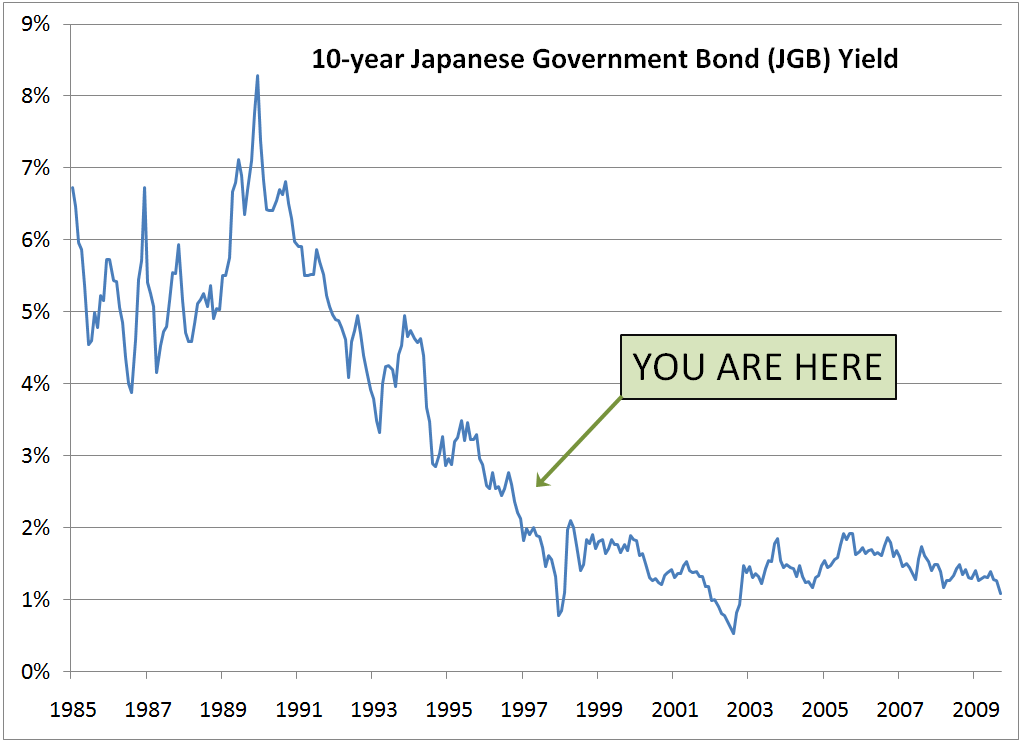
Japan isn't a perfect template of what lies ahead for the United States. But given the decisions we've made so far and our cultural/political policy of exchanging short-term, acute pain for prolonged suffering, I think Japan is as relevant a bit of economic history for us as any.
Sure, the printing-press-powered inflationary scenario could materialize instead. But that would be even worse for your bonds than the Japan-esque long-term deflationary death spiral.
Here's an idea with a better shot at getting you through either outcome:
How to play it
The trade is long term and there are two parts.
The first part is to stay long bonds. Do that any way you choose. Go buy an ETF like TLT (TLT) if you're feeling aggressive, and if you hail from Gary Shilling's deflationary camp, go ahead and follow him into the 30-year bond. If you're more risk-averse, check out something closer to the front end of the yield curve like the 1-3 year Treasury (SHY) or the 3-7 year Treasury (IEI) if you want a little more yield. You're even fine with PIMCO's own Total Return Fund (PTTAX).
Part two happens when (or preferably shortly before) the bond party finally does end. Unlike a college fraternity kegger, it'll be a bit more difficult to identify exactly when the fun stops. There will be no flashing blue and red lights pulling up outside. So keep your eyes peeled abroad and don't stay focused on just the bond market. When we get the next big equity washout -- and don't worry, we will get at least one washout in the next few years -- that'll be time to sell all your bond funds. Then simply load up on high-quality, strong-dividend equities. Stuff like Johnson & Johnson (JNJ), Intel (INTC), AT&T (T) or Verizon (VZ), Royal Dutch Shell (RDS.A), Coca Cola (KO), Kraft (KFT), or McDonald's (MCD). You know, the usual suspects.
I know that sounds really simple right now. But trust me, this is a much harder trade to execute properly than you might think. It requires zigging today while everyone is zagging, and zagging later on when everybody has decided to zig. Getting long the 30-year Treasury is a very unpopular trade right now, and I guarantee that buying equities during the next correction will be equally unpopular. But aren't the toughest trades usually the best? Isn't there a reason why we need maxims like "buy when there's blood in the streets" to steel our resolve and help us pull the trigger?
So there you go. There's a roadmap for the next decade. There's risk in this strategy, but it's manageable and I believe that the rewards relative to that level of risk are attractive. I think it's a way to keep pace with average annual market returns of 4-6% but without the 50% drawdowns. It's a nice variant on Jeremy Grantham's macro strategy of "hold cash and wait."
About the author: Jeffrey Dow Jones
Friday, November 19, 2010
Markets 11-19-10
Markets have been bouncing around the past 5 days. Great day yesterday in Equity, very lousy day Tuesday. Yesterday the Philadelphia ISM index showed a marked increase in manufacturing activity and the market soared. Problem is with one chart I have been following - inventory buildup. While manufacturing countrywide has been increasing, buildup of inventories, as shown in the chart below, has been outstripping new Orders. This does not bode well for continued recovery from the recession. Global problems are also coming back to the forefront with Ireland failing and will most probably be bailed out. Spain or Italy should be next to hit the news. Biggest global problem is China which now rules the world. China is tightening its financial system and will likely raise rates to slow inflationary forces.
So I am continuing with orderly pullback in allocations to Equity and also Fixed investments. Raising cash levels dramatically. I much prefer to forego some more upside gains to avoid the growing downside risks.

So I am continuing with orderly pullback in allocations to Equity and also Fixed investments. Raising cash levels dramatically. I much prefer to forego some more upside gains to avoid the growing downside risks.
Wednesday, November 17, 2010
Friday, November 12, 2010
Markets as of 11/12/10
Interesting day with just about every equity sector going down, bonds down, gold down. Markets are now looking at Bad news and ignoring good news. For instance, the Michigan Consumer Confidence number came in today and was positive, which normally sends the equtiy market up. Markets just ignored it and kept going down. Question now is to determine if this shift in investor sentiment is short term and might change back next week, or if it is a structural type change and the markets will keep going down next week. It is too early to tell. I think Monday and Tuesday market action will give us the answer. Important not to panic, but stay diversified and stay disciplined. I will be moving some more money next week into safer investments regardless if stocks go up or down next week. I also still like Gold longer term and I am buying on price drops.
Tuesday, November 9, 2010
Market as of 11-9-10
I am holding to what I stated last week. Gradually putting money into safer assets ie cash, short term fixed since this market has gone up so much. Focusing on large cap stocks and stock funds. Favorite sectors right now are Financials and Energy. I am still waiting and will continue to wait for the eventual opportunity to short long term fixed income.
Thursday, November 4, 2010
Market Euphoria as of 11-4-10
This has been a wild week in the markets, first the elections, then Ben Bernanke's QE2 announcement. If you are a longer term investor and you have your portfolio diversified in good quality stocks, and shorter term bonds, some commodities, maybe some real estate - you had a very rewarding week. I am writing this just before the employment figures get released tomorrow at 8:30 so things could of course change.
If you are a fairly active trader, you may have had a fairly confusing and frustrating week. The markets moved drastically, especially on Wednesday after the Fed announcement. Today, all you had to do was throw darts at the wall and you made money.
So now what?
There is market momentum that is hard to short right now. This could go on for a while with stocks and commodities moving higher. However, as noted in previous remarks, the average investor is now stepping back into the market, a move which usually signals we are nearing a Top.
Short Term players - I would consider taking some money off the table, tightening stops ( I do hope everyone uses Stop Loss transactions just in case), and starting to hedge positions. The market has had a terrific run these past 2 months and now is not the time to be greedy. Putting some money in safer investments does not mean we think the market is going to go down. It is a safety move because nasty events have a habit of appearing suddenly and causing drastic moves in the market. No such moves are expected right now, investors are turning euphoric meaning they think the markets will go straight up into next year. That always makes me cautious. What I suggest doing in markets such as this is Dollar Cost Average Out ie start withdrawing money from stocks into safer investments on a schedule, and putting in tighter Stop Loss orders. Bonds - keep them short duration.
Long Term investors and 401k participants - I would review investment allocations to ensure equity investments are in Large Cap funds that hold a lot of dividend paying stocks. Bonds should be in shorter duration fund options. Money Market holdings should be increased to "take some profits off the table". New contributions should be going into safer investments rather than being invested in Stock funds at these high valuations - wait for a pull back before allocating these contributions into stock funds.
If you are a fairly active trader, you may have had a fairly confusing and frustrating week. The markets moved drastically, especially on Wednesday after the Fed announcement. Today, all you had to do was throw darts at the wall and you made money.
So now what?
There is market momentum that is hard to short right now. This could go on for a while with stocks and commodities moving higher. However, as noted in previous remarks, the average investor is now stepping back into the market, a move which usually signals we are nearing a Top.
Short Term players - I would consider taking some money off the table, tightening stops ( I do hope everyone uses Stop Loss transactions just in case), and starting to hedge positions. The market has had a terrific run these past 2 months and now is not the time to be greedy. Putting some money in safer investments does not mean we think the market is going to go down. It is a safety move because nasty events have a habit of appearing suddenly and causing drastic moves in the market. No such moves are expected right now, investors are turning euphoric meaning they think the markets will go straight up into next year. That always makes me cautious. What I suggest doing in markets such as this is Dollar Cost Average Out ie start withdrawing money from stocks into safer investments on a schedule, and putting in tighter Stop Loss orders. Bonds - keep them short duration.
Long Term investors and 401k participants - I would review investment allocations to ensure equity investments are in Large Cap funds that hold a lot of dividend paying stocks. Bonds should be in shorter duration fund options. Money Market holdings should be increased to "take some profits off the table". New contributions should be going into safer investments rather than being invested in Stock funds at these high valuations - wait for a pull back before allocating these contributions into stock funds.
Wednesday, November 3, 2010
Bond Market 11-3-10
It will be interesting to see what happens to bonds this afternoon when the Fed announces its QE2 plans. I have seen rationale for both rising and falling bond prices. However, once we get past this news, there is little disagreement about the future of the bond market - there is little upside potential and a lot of downside risk.
Bonds can only keep going up if interest rates keep falling. Problem is there is not much room left for interest rates to fall. If these record low interest rates stay steady for the next year, then bond prices should remain relatively steady for the next year. But inflation is coming - it has to given all the government spending and now QE2 which is just printing more dollars. The only question in the investment community is When - this month, by year end, by next summer.
In the classes I teach, I consistently hear people talk about putting most of their money in bonds funds thinking they are safe vs. the stock market which they view as a casino. This is not the way to view these two markets and bond fund holders are going to be sorry over the next several years.
Here is an article by Bill Gross at Pacific Investment Management (PIMCO), one of the country's most respected Bond Managers. Please take heed.
http://www.thestreet.com/story/10902225/bill-gross-qe2-signals-end-of-bond-rally.html
Bonds can only keep going up if interest rates keep falling. Problem is there is not much room left for interest rates to fall. If these record low interest rates stay steady for the next year, then bond prices should remain relatively steady for the next year. But inflation is coming - it has to given all the government spending and now QE2 which is just printing more dollars. The only question in the investment community is When - this month, by year end, by next summer.
In the classes I teach, I consistently hear people talk about putting most of their money in bonds funds thinking they are safe vs. the stock market which they view as a casino. This is not the way to view these two markets and bond fund holders are going to be sorry over the next several years.
Here is an article by Bill Gross at Pacific Investment Management (PIMCO), one of the country's most respected Bond Managers. Please take heed.
http://www.thestreet.com/story/10902225/bill-gross-qe2-signals-end-of-bond-rally.html
Wednesday, October 27, 2010
Annual expenses lower in ETFs vs. Mutual Funds
Question asked during Adult Ed Investment class tonight.
Question was why are ETF annual expenses lower than mutual fund expenses, even indexed funds.
"Lower costs
Expenses can have a significant impact on returns for investors. ETFs, in general, have significantly lower annual expense ratios than other investment products. ETFs are less likely to experience high management fees because they are index-based, not “actively” managed. And, since they trade on an exchange, ETFs are insulated from the costs of having to buy and sell securities to accommodate shareholder purchases and redemptions".
Expenses can have a significant impact on returns for investors. ETFs, in general, have significantly lower annual expense ratios than other investment products. ETFs are less likely to experience high management fees because they are index-based, not “actively” managed. And, since they trade on an exchange, ETFs are insulated from the costs of having to buy and sell securities to accommodate shareholder purchases and redemptions".
I took the above excerpt from the articles on my website. You might want to read all the articles since they are fairly comprehensive.
here is the page which has 4 articles on it so scroll down:
Tuesday, October 26, 2010
Bull, Bear or Neutral
OK, so what am I normally - Bull, Bear or neutral?
Normally I am bullish and have been so for the past 2 years. Starting 1 month ago I changed to mild Bear.
Why? I think the upcoming move by the Fed, which is already baked into the markets, will not achieve anything but artificial bubbles in the equity, bond and commodity markets. Below is a very good article recently on what the Fed is doing and why it is ludicrous. This does not mean that I am out of the market, but I am not "all in". I have also started hedging equities. Concerning Fixed markets, I think the future best investment will be to short bonds, mainly in the 20 year maturity area. However I do not think it is time yet to start the shorting - maybe by year end depending upone the effect of the Fed QE2.
-- Dr. John Hussman, "Bernanke Leaps Into a Liquidity Trap"
Normally I am bullish and have been so for the past 2 years. Starting 1 month ago I changed to mild Bear.
Why? I think the upcoming move by the Fed, which is already baked into the markets, will not achieve anything but artificial bubbles in the equity, bond and commodity markets. Below is a very good article recently on what the Fed is doing and why it is ludicrous. This does not mean that I am out of the market, but I am not "all in". I have also started hedging equities. Concerning Fixed markets, I think the future best investment will be to short bonds, mainly in the 20 year maturity area. However I do not think it is time yet to start the shorting - maybe by year end depending upone the effect of the Fed QE2.
-- Dr. John Hussman, "Bernanke Leaps Into a Liquidity Trap"
Subscribe to:
Posts (Atom)